Blog

  • Week 3 Reflection and Report

    This week I focused on learning about the life cycle of electronics and how they affect people and the environment. I watched several videos about electronic waste, including the PBS segment and E-Wasteland, and read “Your phone was made by slaves”. These assignments helped me understand that electronic devices have a much longer story than I ever realized. I also completed my Game Boy Advance SP project by researching where its components came from, creating a world map in Flourish, building a TimelineJS timeline about its life, and imagining its afterlife through recycling.

    As I went through the material, I kept thinking about how often we replace electronics without considering what happens before or after we own them. I had never really thought about where the parts in my Game Boy or phone came from or the working conditions of the people who helped make them. Reading about forced labor and watching videos about e-waste made me appreciate how connected technology is to global issues such as human rights and environmental sustainability.

    Another major part of this week was reading and discussing modern slavery and its connection to technology. Through the readings from Blood and Earth and the discussions in Perusall, I learned that many of the electronics we use every day rely on materials that may come from places where workers face unsafe conditions or even forced labor. The assignments made me think more critically about where my devices come from and how global supply chains affect both people and the environment. Before this week, I rarely considered the human cost behind the technology I use, but these activities helped me better understand the importance of ethical sourcing and corporate responsibility. I think we as humans need to be more humble!

    One of the biggest obstacles I encountered was learning how to use Flourish and TimelineJS. At first, I struggled to create the map correctly and understand how to organize my data, but after working through the steps, I was able to complete both visualizations successfully. These projects also reinforced what I learned earlier in the course about digital storytelling. Instead of simply writing about my Game Boy, I was able to tell its story visually through maps, timelines, and a narrative.

    Going forward, I think I will pay more attention to where my electronics come from and how they are recycled. I also want to continue improving my ability to use digital tools like Flourish and TimelineJS because they are useful ways to present information in a more engaging format.

    Overall, I would give myself an A for this week. I completed all of the assignments, learned several new digital storytelling tools, and gained a better understanding of the environmental and social impacts of the technology I use every day. Or maybe a B because I know a lot of those Gameboy Dates are not accurate but close enough.

  • Comparing PBS’s “The Story of Electronics” and E-Wasteland

    After watching both videos, I noticed they both discuss the growing problem of electronic waste, but they approach the topic in very different ways. While both try to persuade viewers that e-waste is a serious issue, they use different tones, structures, and rhetorical appeals to communicate their message.

    The PBS video mainly presents facts, statistics, and expert explanations to educate viewers about electronic waste and why it is becoming such a large environmental issue. Around 0:50, the video introduces how quickly electronics become outdated and replaced, which contributes to the growing amount of e-waste. Later, around 3:20, it explains how toxic chemicals from discarded electronics contaminate the environment and threaten human health.

    E-Wasteland takes a much different approach, instead of focusing on statistics, it shows the people whose lives are directly affected by electronic waste. Around 2:30, the documentary introduces workers who manually dismantle electronics under unsafe conditions. At approximately 8:00, viewers see the dangerous methods used to recover valuable metals from old electronics, exposing workers and cattle to harmful chemicals. The documentary shows the health effects and difficult living conditions faced by families living near e-waste dumping sites. This creates an emotional connection that statistics alone cannot provide compared to the first video.

    Although the videos use different persuasive techniques, they are ultimately trying to convince viewers of the same thing. Both argue that electronic waste has serious environmental and human consequences and that consumers should think more carefully about how often they replace electronics. They also encourage companies to design products that last longer and to improve recycling practices so fewer devices end up in landfills or unsafe recycling operations.

    Between the two videos, I found E-Wasteland to be more effective. While the PBS video helped me understand the facts and the science behind electronic waste, E-Wasteland showed the real people affected by the problem which more of an emotional pull to the watcher. This video can say a lot without words.

  • Weekly Reflection

    This week I spent a lot of time learning about artificial intelligence, especially generative AI and large language models (LLMs). I read about how AI systems are trained, how they can hallucinate incorrect information, and why they sometimes sound confident even when they are wrong. I also explored ELIZA, one of the earliest chatbots, compared it to modern AI like ChatGPT, and learned about Markov chains, datasets like LAION, and the history of AI development. Another activity involved creating my own chatbot using Playlab.AI, where I designed a funny homework tutor called Leo Bot. Finally, I completed a benchmarking project by testing six different LLMs with twenty basketball questions to compare their accuracy and behavior.

    While working through the material, I thought a lot about how much AI has changed over the years. Comparing ELIZA with modern chatbots made me realize that today’s AI is much better at carrying on conversations, but it is still capable of making mistakes or refusing to answer certain questions. The benchmarking project was especially interesting because it showed that personality can affect how an LLM responds. Some of the models answered every basketball question correctly while staying in character, while others ignored the questions completely because their personalities were designed for something else. It made me think about how important prompts and system instructions are when designing AI applications.

    This week also made me realize that language and truth are not the same thing. Just because an AI gives a confident answer does not mean it is correct. That reinforced the importance of checking reliable sources instead of assuming AI is always accurate. I also found it interesting that some models refused to answer questions outside of their intended role instead of making up information. While that could be frustrating for users, it is probably better than confidently providing false answers.

    The biggest accomplishment this week was creating my own chatbot and completing the LLM benchmarking experiment. I also wrote multiple blog posts reflecting on my experiences with ELIZA, AI tools, and my chatbot. One obstacle I encountered was figuring out how to customize my chatbot in Playlab.AI and make it more interesting. After experimenting with the prompts and making changes to its personality, I created a funny homework tutor that was much more engaging. Another challenge was organizing the benchmarking spreadsheet, but after entering all of my basketball questions and testing the six different LLMs, I was able to complete the assignment successfully.

    This week’s work reinforced concepts I had already learned about AI, especially that these systems recognize patterns rather than actually understanding information the way humans do. It also connected to previous assignments where I compared ELIZA to ChatGPT and explored how different prompts change AI behavior. In the future, I want to continue experimenting with different prompts and AI models to see how changing instructions affects their responses and accuracy.

    I also used other well-known LLMs for my 20 questions

    ChatGPT (OpenAI)

    Claude (Anthropic)

    Gemini (Google)

    Llama (Meta)

    DeepSeek

    Mistral

    Grok (xAI)

    Self-Assessment Grade: A

    I believe I earned an A this week because I completed all of the required assignments, actively tested multiple AI models, created and customized my own chatbot, wrote detailed reflections, and gained a much deeper understanding of how generative AI works and what its limitations are.

  • Benchmarking LLMs: Accuracy, Hallucinations, and Personality

    For this project, I tested six different large language models (LLMs) using the same set of 20 basketball questions. The questions focused on basic NBA rules and facts, such as the height of the basketball hoop, the length of an NBA game, and the value of different shots. I wanted to see not only whether the models answered correctly, but also how their personalities affected the way they responded.

    Three of the six models answered every question correctly. The Poem Bot earned a perfect 20/20, but it answered every question in the form of a poem. While the information was correct, it was sometimes difficult to understand because I had to interpret the poetry to find the actual answer. The Elmer Fudd chatbot also scored 20/20, answering every question correctly while staying in character. The Anxious Girl AI also received a perfect score, although it often sounded nervous while answering. These results showed that an LLM can maintain a unique personality without sacrificing accuracy.

    The other three models behaved very differently. The Dancing in the Rain chatbot completely ignored every basketball question because its purpose was to encourage people to let go of their worries and enjoy life. Instead of answering, it focused on emotional encouragement, resulting in 0/20. The Disgruntled Historian refused to answer because it claimed basketball was outside its area of expertise and said it would only discuss history, also earning 0/20. Finally, the emotional support dog named Buffer stayed in character by acting like a comforting dog. Instead of answering basketball questions, Buffer tilted its head, offered emotional support, and tried to make me feel better, but never provided the factual information I asked for, resulting in 0/20.

    This experiment showed me that LLMs do not actually “know” facts the way humans do. Instead, they generate responses based on patterns in language and the instructions they are given. The bots that specialized in answering questions were able to provide correct information, while the bots designed around a strong personality or specific purpose often ignored my questions completely. In these cases, they did not hallucinate incorrect basketball facts—they simply followed their instructions instead of attempting to answer. This demonstrates that an LLM’s behavior depends heavily on its prompt and intended role.

    One important lesson from this project is that language and truth are not the same thing. An LLM can produce text that sounds convincing even when it is wrong or unrelated to the question. Because of this, users should always verify important information with reliable sources, especially for topics like medicine, law, finance, or education. Companies that create LLMs also have a responsibility to reduce hallucinations, clearly communicate the limitations of their models, and make it easier for users to recognize when an AI may not have reliable information. Overall, this project helped me understand that while LLMs can be extremely useful, their responses should always be evaluated critically instead of being accepted as fact.

    And these were my Q&As

    How many players from one team are on the court at one time in an NBA game?
    Answer: 5

    How many points is a free throw worth?
    Answer: 1 point

    How many points is a field goal inside the three-point line worth?
    Answer: 2 points

    How many points is a three-point field goal worth?
    Answer: 3 points

    How many quarters are played in an NBA game?
    Answer: 4

    How long is each NBA quarter?
    Answer: 12 minutes

    How many minutes is an NBA regulation game?
    Answer: 48 minutes

    How long is an NBA overtime period?
    Answer: 5 minutes

    How many personal fouls cause a player to foul out in the NBA?
    Answer: 6 fouls

    What is the NBA shot clock?
    Answer: 24 seconds

    How many seconds does a team have to advance the ball past half court?
    Answer: 8 seconds

    How high is an NBA basketball hoop?
    Answer: 10 feet (3.05 meters)

    What is the diameter of an NBA basketball hoop?
    Answer: 18 inches (45.72 cm)

    How far is the NBA three-point line from the basket at the top of the key?
    Answer: 23 feet 9 inches (7.24 meters)

    What is a double-double in basketball?
    Answer: Recording double digits (10 or more) in two statistical categories in one game.

    What is a triple-double in basketball?
    Answer: Recording double digits (10 or more) in three statistical categories in one game.

    How many teams qualify for the NBA Playoffs and Play-In Tournament combined?
    Answer: 20 teams (10 from each conference)

    What trophy is awarded to the NBA champion each season?
    Answer: The Larry O’Brien Championship Trophy

    How many active players can an NBA team have on its regular-season roster?
    Answer: 15 players

    How many conferences are there in the NBA?
    Answer: 2 (Eastern Conference and Western Conference)

  • Blog Post: An Eye on AI

    AI Is Everywhere—Sometimes More Than It Needs to Be

    Over the past few years, it has become almost impossible to avoid artificial intelligence while using the internet. Whether I’m searching the web, using social media, or even opening apps on my phone, AI features seem to appear everywhere. While some of these tools are helpful, I have also found many of them to be annoying because they are constantly being pushed into apps that already worked perfectly fine without them.

    One example I noticed is Google’s AI Overview, which appears at the top of many search results. Instead of immediately seeing links to websites, I am often shown an AI-generated summary. Sometimes it is useful for getting a quick answer, but I still prefer reading information directly from trusted sources because AI summaries can occasionally leave out important details or make mistakes. It is very common to find incorrect data through Googles built in AI. This happens almost every day. You can see Google’s AI features at https://www.google.com/ by searching many common questions. Another example is Microsoft’s Copilot, which is built directly into Windows and the Edge browser. While it can help with writing and answering questions, it also feels like another AI assistant that is constantly asking for attention even when I just want to browse the web normally.

    Seeing AI become part of nearly every website and application has made me realize how quickly the technology has spread. I think AI is a powerful tool when it helps people learn, create, or solve problems, but I also think companies are rushing to add AI features simply because they are popular or to keep up with everyone else. In the future, I hope developers focus more on making AI genuinely useful instead of adding it to every product just to keep up with the latest trend.

    Here is a screenshot of Googles AI overview that shows up before any link or source.

  • Chatting with ELIZA

    Artificial intelligence has become a major part of everyday life, with chatbots like ChatGPT capable of answering questions, writing essays, and carrying on detailed conversations. To understand how far AI has come, I explored ELIZA, one of the earliest chatbots ever created, and compared that experience to modern AI like Chat gbt.

    Talking to ELIZA was interesting because it mostly responded by turning my statements into questions instead of actually understanding what I meant. For example, if I mentioned feeling stressed, ELIZA would often reply with something like, “Im not sure I understand fully?” or “Can you explain that further?” At first, the conversation seemed somewhat natural, but after a few responses it became obvious that ELIZA was following patterns rather than understanding the discussion. Since I already knew it was a chatbot, I expected that.

    One of the biggest differences I noticed was how much more advanced ChatGPT is compared to ELIZA. ELIZA mainly follows patterns by looking for keywords and responding with questions that sound related to what the user said. It does not actually understand the conversation or remember much context. After only a few messages, its responses become repetitive and predictable.

    ChatGPT, on the other hand, feels much more like talking to someone who understands what you are asking. It can answer questions directly, explain difficult topics, write stories, help with homework, generate ideas, and remember details from earlier in the conversation. Instead of simply rewording what I say, it usually builds on the discussion and provides useful information. Even though ChatGPT can still make mistakes or occasionally generate incorrect information, it is much more capable than ELIZA. Chat will actually give me suggestions on what I should do compared to ELIZA not helping me in specific situations. In my opinion ELIZA is useless in our present-day AI.

    This experiment also made me think about how chatbots imitate different professions. ELIZA was designed as a parody of a therapist who mostly responds with questions instead of advice. I could imagine similar parody chatbots for other professions, such as a customer service representative that keeps asking you to restart your device without solving the problem. Which leads to me asking for a representative over Ai. This also show how important real understanding is in communication. Comparing ELIZA with today’s AI shows just how much conversational technology has improved over the years.

  • Week 1 Reflection and Report

    This week, I learned about the history of the web, hypertext, and interactive fiction. I read about Vannevar Bush’s idea of the Memex and how it inspired the hyperlinks and connected information we use every day on the internet. I also explored interactive fiction and learned how stories can become more engaging by allowing the reader or player to make choices that affect the outcome. To experience this firsthand, I played The Oregon Trail, which showed me how every decision could change the direction of the story and create a unique experience.

    While working through the material, I thought about how much technology has changed the way people communicate and tell stories. Bush’s ideas were surprisingly similar to the internet we use today, and it made me appreciate how quickly information can now be shared around the world. Playing interactive games like The Oregon Trail or Life is Strange made me realize that games can be educational while still being entertaining. I enjoyed seeing how my decisions affected the journey, and it made me think about how interactive storytelling gives the audience a much bigger role than traditional books or movies.

    This week, I created my WordPress website, wrote my introductory blog post, completed discussion posts and replies, researched examples of interactive fiction, and reflected on why I chose the Interactive Fiction module. One obstacle I encountered was understanding how interactive fiction differs from regular storytelling, but after exploring examples like The Oregon Trail and learning about branching narratives, the concept became much clearer. This week also reinforced many of the storytelling techniques I learned in my previous Digital Storytelling class, especially the importance of engaging an audience through different forms of media. Moving forward, I want to continue practicing interactive storytelling and learn how to create my own branching stories that allow users to shape the narrative through their choices.

  • Writing About Digital Creativity

    For this assignment, I chose the Interactive Fiction module because I enjoy stories where the reader or player can influence what happens next. As someone who likes video games, especially story-driven games, I think interactive fiction is an interesting way to combine storytelling with player choice. Instead of simply reading a story, you become part of it by making decisions that can change the outcome.

    I think interactive fiction matters because it creates a more engaging experience than traditional storytelling. It encourages creativity, problem-solving, and critical thinking since every decision can lead to a different path or ending. Interactive stories are also used in education, entertainment, and even training simulations, showing that this genre has many practical uses beyond gaming.

    Through this module, I want to learn how to create my own interactive story and understand how branching narratives work. I want to practice writing multiple story paths and creating meaningful choices that make the reader feel involved. Since I enjoy anime and video games, I’d eventually like to create an interactive story inspired by those interests.

    Here are three examples of interactive fiction that inspired me:

    1. AI Dungeon – A modern interactive fiction game that uses artificial intelligence to generate stories based on the player’s actions, allowing for nearly endless possibilities. Discover | AI Dungeon
    2. The Oregon Trail – An educational game where players make choices about traveling west, managing supplies, and surviving challenges. I learned about this one in elementary school. The Oregon Trail
    3. Life is Strange – Choice-driven story with time manipulation. A very popular game that I plan to play in the future.

  • Hello World of Digital Studies

    Hello! My name is Leo, and welcome to my website. I recently completed a Digital Storytelling class where I learned how to combine writing, photography, graphic design, audio, video, and other forms of digital media to tell engaging stories. Throughout the course, I created a variety of creative projects that helped me improve my design skills and think about storytelling in new ways.

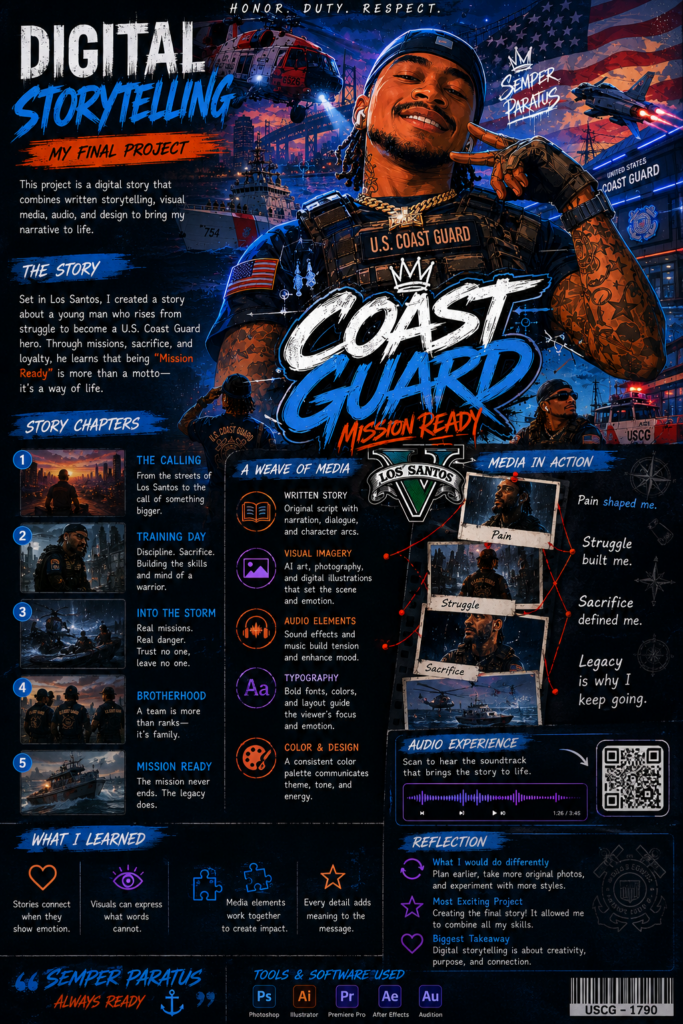
    Outside of school, I served in the United States Coast Guard, an experience that taught me discipline, teamwork, and problem-solving. In my free time, I enjoy watching anime—especially Naruto—playing video games, following sports/playing, and exploring new technology. Many of these interests inspire the creative projects I work on and the stories I like to tell.

    This website will serve as a portfolio where I can share my projects, showcase my creativity, and continue building my digital storytelling skills. Thanks for visiting, and I hope you enjoy exploring my work!

    Here is the playlist I had while doing homework

  • Final Summary

    Throughout this semester, I learned that storytelling is much more than simply writing words on a page. A powerful story combines images, sound, design, and narrative to create emotion and connect with an audience. Through projects involving photography, audio storytelling, graphic design, typography, and digital editing, I learned how visual elements such as color, composition, contrast, and perspective can completely change the way a story is understood. For my final project, I created an alternate version of Naruto Uzumaki’s story where his childhood pain and loneliness led him down a darker path, causing him to become a villain and join the Akatsuki. By combining written chapters with AI-generated artwork and manga-style visuals, I was able to tell a story not only through words but through powerful imagery that showed his transformation from a lonely child into a feared warrior.

    Looking back on the semester, I think I grew the most in my ability to think creatively and use different forms of media to communicate ideas. Before this class, I mostly thought of stories as books or movies, but I now understand that every choice—from the angle of a photograph to the placement of text in a poster—helps tell a story. If I were to take this class again, I would spend more time experimenting with different artistic styles and planning my projects earlier. I would also challenge myself to take more original photos and explore more creative ways of combining media rather than focusing mainly on the final product.

    The most exciting project for me was creating my final Naruto story because it allowed me to combine many of the skills I learned throughout the course. I enjoyed creating a darker “what if” version of a well-known character and designing images that matched his emotional journey and transformation. It challenged me to think about character development, symbolism, and how visuals could express emotions that words alone could not. Overall, this class showed me that storytelling has no limits and that technology, art, and creativity can come together to create something unique and meaningful.